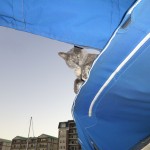
This gallery contains 10 photos.
We are heartbroken. A couple of weeks ago we found Penny the Cat on the front lawn, dead. She had been gone all night and we were worried. When I went to work in the AM she was nowhere to … Continue reading


This gallery contains 10 photos.
We are heartbroken. A couple of weeks ago we found Penny the Cat on the front lawn, dead. She had been gone all night and we were worried. When I went to work in the AM she was nowhere to … Continue reading
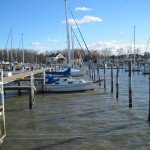
This gallery contains 7 photos.
I went to the marina yesterday to do some work. It looks like a strong wind sucked most of the water out of the creek. I haven’t seen the water this low since Hurricane Sandy. The step from the finger … Continue reading
I’m spending the night on the boat, as I try to do a couple times a week. It is in the lowish 30s. I’m snug as a bug in a rug when, quite rudely at 0400, I am woken by the insistent chirp chirp chirp chirp of my Fireboy-Xintex Carbon Monoxide Detector. Shit. I tumble out of bed, open the hatches (brrr), and start the fans. The alarm happily silences after about fifteen or twenty minutes.
What the hell just happened?
The boat is being heated with a 700 watt miniature radiator style Homebasix CYPB-7 Mini Oil Filled Radiator, which seems a bit undersized, so I supplemented with a little ceramic Holmes HFH103-UM Compact Heater Fan. It is electric heat and shouldn’t generate any carbon monoxide. I did light the lantern for awhile last night, and I cooked dinner onboard, but given the hours that have passed, I don’t think they could really be a factor either. When opening the hatches I listened carefully for any sounds of generators or engines. Nothing. The marina is a ghost town. Where did the CO come from?
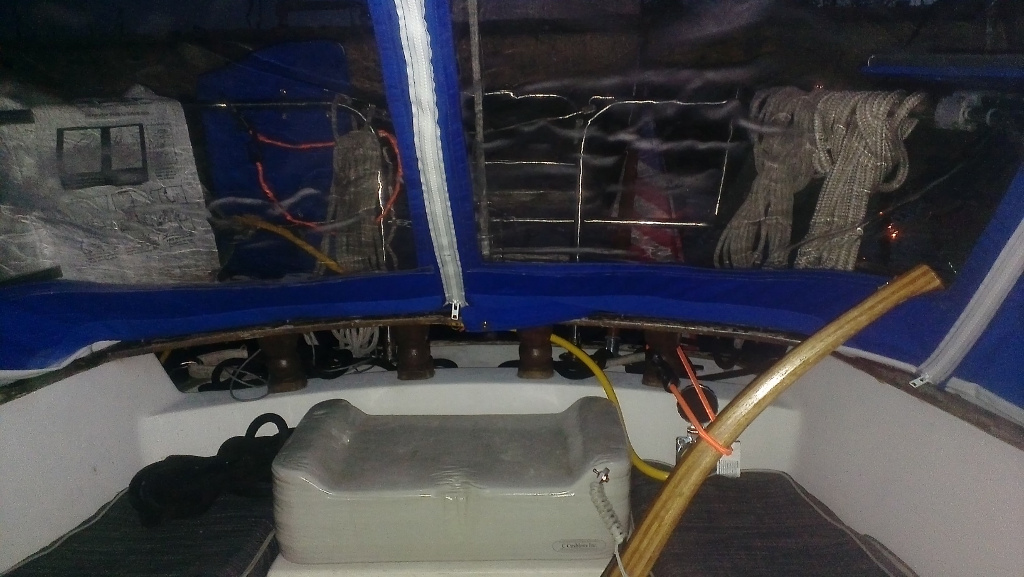 Besides the mysterious introduction of CO to the cabin, I wonder why it lingered. I have a cockpit enclosure but there are big areas for ventilation as it attaches to a taffrail that is five inches off the deck. Surely there is more than enough air exchange. I do have some curtains in the cabin to close off the main area from the galley/navigation area, and from the head in order to contain warmth (and, I guess CO); but they are several inches off the sole to aid compartment to compartment ventilation (and, being curtains, aren’t exactly air tight). The top drop board has about 60 square inches of screened opening protected with a rain shield, and a one inch gap between the top board and the sliding hatch. I would think this is plenty of ventilation. I have only a small solar vent in the forward head, so perhaps there is inadequate through venting, but the total lack of interior condensation suggests to me that the whole ventilation is working fairly well.
I had a very minor headache, that eased over an hour or so; but I’m not sure if that is from CO poisoning or from waking up hours before normal. I’m prone to headaches, normally, so I’m not terribly confident in using them as a symptom. I don’t have any other symptoms that I can associate with CO poisoning.
Best guess: somewhere out there someone is running an engine, generator or heater, and somehow the CO managed to make its’ way to my boat and get sucked in through the cockpit enclosure and into the cabin. It seems rather unlikely; but what else can it be?
I’m now snuggled in my bunk warming up with a healthy new paranoia. I’m leaving the curtains open and the top drop board out to increase the airflow, suddenly comfortable with the chill of a cold morning and happy that I went to the hassle and expense of installing the CO detector. I’m not sure how dangerous things really were; but figure since I woke up readily without any disorientation (strangely, not even the usual morning just awake groggy disorientation) or other significant symptom (outside of the questionable headache) I tend to feel the levels may have been unhealthy, but not yet critical. However, since dying in my sleep would be a significant detriment to the adventures I have planned, I am glad the detector is there and working.
Carbon Monoxide Poisoning Symptoms:
Spending quality time on the boat working on a bunch of little projects…
Finally vented the Natures Head composting toilet outside into the deck anchor locker. I was temporarily just having it vent into the below decks chain locker, which was mostly OK; but once in awhile (after particularly heavy use) I’d get a whiff of something I generally prefer not to think about. I think finally finishing this project will take care of this occasional issue.
I removed the door to the head and replaced it with a curtain. Oh, sure, the door gave a more finished appearance and contributed to the illusion of privacy; but when open it intruded into the cabin way too much, and since it needs to remain open to get the benefit of ventilation through the fore-hatch, the curtain becomes more than a bit more practical. Besides, the door knob broke on the door. And it usually didn’t shut right anyway.
I installed a new 110VAC electrical outlet on the front of the starboard bunk. Since I prefer to keep all AC power cords safely tucked inside conduit, this was more work than I anticipated. The new outlet will allow running the miniature oil filled radiator style portable heater I purchased without having to plug it into an extension cord. It also is in a convenient place for plugging in an electric blanket, if I go that route.
Regarding the heater, I stayed on the boat last night and the temps dropped to the low 30s. While the heater managed to keep the boat in the mid sixties during the evening, as it got later the inside temperature dropped into the mid-fifties. Not really horrible; but cooler than I’d like. I think for real winter temperatures the boat just won’t qualify as the comfy warm cocoon that I desire. At least not with this little 700 watt heater. UNLESS, perhaps, I slide up the dividers between the galley/nav station and the main cabin area (they are really cool…I should take photos), and perhaps add a dividing curtain there as well. Then, with a smaller area to heat, I think the little heater might be able to keep up. If it doesn’t work I can always buy a bigger portable heater (or install a built in heater), or better yet, just stay in the nicely heated girlfriend’s house, with the very snugly and nicely heated girlfriend.
I installed the Nature’s Head after having an unfortunate experience last year with an over filled holding tank (a very messy version of Old Faithful was the odorous result). I had considered making a home-brew version (off the shelf parts would be sweet); but my time is not unlimited and I had other things to spend it on (rewiring the boat, for starters). The boat show price was high; but not unreasonably so.
With me and my gal, the two plus gallon liquids container generally needs emptying every other day. I do have a spare jug which I feel is mandatory and should come standard. I will soon be making a custom fit bracket to snugly hold the spare jug to the bulkhead to reduce the risk of it going flying and spilling the contents all over the interior (a horrifying thought).
The solids container does seem to last quite awhile; but I’m not convinced it makes the advertised 60-80 uses. Of course, if putting the toilet paper in the head (and it is somewhat distasteful to put it anywhere else), it will fill up much faster. The TP takes some time to break down. The poop does become inoffensive in a couple of days, although it surely takes much longer to fully compost than the practical time it can remain in the toilet. There is rarely a smell (the cat box is much more of an issue). The small fan barely registers on the amp meter and does an admirable job of venting to the anchor locker.
Dumping:
From a philosophical point of view, I think that discreetly pouring pee overboard is not much of a health risk anyplace that is not unusually sensitive and not morally shaky, unless it done in a really crowded harbor at which point it is bad manners. Legally is a different thing altogether, and I’m pretty certain it is universally frowned upon by those men with shiny badges. You makes your choices and you takes your chances. It should be easy enough to find a shore side facility every two or three days, although I can think of more pleasant things than carrying around a couple of gallons of smelly pee.
By the same token, I think that putting partially composted solid waste in a thick contractors trash bag (the Nature’s Head site suggests a regular kitchen garbage bag…given the subject matter I think I prefer the extra toughness of the thick bags) and putting it into the dumpster is no more offensive or generally harmful to mankind than disposing of dirty baby diapers in the trash; but it may still be illegal. The Nature’s Head folks suggest it is dirt at this point (assuming some time between last deposit); but I am not certain that it really, truly qualifies without having at least months of time to cook. Choices. Chances. I read somewhere (the c-head homepage, perhaps) that sealing it in a pickle bucket (aka Home Depot ‘Homer’ bucket) with some bleach qualifies it as “treated” and it suddenly becomes legal for about the same price as a pump out. I’m not sure; but it sounds like a reasonable compromise assuming an offshore dump is not practical. I emptied mine after using it occasionally all summer plus regularly for a ten day trip for two. It was not anymore distasteful than a pump out, and more pleasant than dealing with a porta-potti. I expect the next time I empty it will be when I recommission the boat next spring. Although I’m now living aboard part-time, so that estimate might not hold true in the end.
The bottom line:
Everything in life is a compromise. But as far as compromises go, this one ain’t that bad. And I no longer have nightmares of exploding holding tanks. Bonus: By pulling the holding tank, I now have room for a new water tank to augment the somewhat anemic twenty gallons of the primary tank. If only I can find an off the shelf tank that would properly fit…
I’ve been bad about blogging. Forgot I had the darn thing, really. Let’s try again. At the moment I’m in the middle of a short ten day cruise on the Chesapeake with my gal Lauren. We continue…
We spent the weather perfect day in the very lovely town of Oxford, MD yesterday, and are getting ready to head to Cambridge as soon as I finish writing. Sadly, we couldn’t get any of the famous home made ice cream (closed now on Tuesdays and Wednesdays along with Schooners). Happily, we met some neat people in some neat boats.
Gordon and Susan on home-built C&C designed 35 foot WHIM of Arne. Apparently Gordon borrowed the mold shortly before it was scheduled for destruction and built himself a new hull. Pretty cool. They are looking for a place to keep the boat for the winter before heading back south jumping on Susan’s Syrena.
Mary T also lives here in the Town Creek for the night. Didn’t get a chance to talk to them much; but they seem like friendly folks. Both Whim and Mary T are heading to Cambridge as well, so maybe we’ll see them there.
One of the cool things about small towns is when it turned out that we couldn’t grab a bite at the close place, help arrived. An old gent named Eddie Frederick saw us looking dejected in front of the closed ice-cream window, took pity, and took us for a drive around town, showing us the different sights and all the different restaurants. He dropped us off at the Masthead restaurant on the other side of town. We had a decent meal there, and very decent (too many, and too expensive) drinks. Afterwards, out server/bartender/bus-gal Meredith actually took us to the little town market (we needed a few supplies) a short walk from the public dinghy dock.
Lauren and I ended the night laying on the foredeck admiring all the stars. We don’t often get to see near so many in Baltimore due to all the light pollution.
A perfect day.
A few weeks ago, at one of the local boat shows, I talked to the Porta-Bote representative.
Up until that time I had fully intended on building another dinghy. Probably something nestable; although I have downloaded a few folding dinghy plans that look interesting. Unfortunately, anything involving boats, and in particular boat-building, even of very simple design, takes time. Sometimes a lot of time. Time is something that is in decidedly short supply, so I decided to buy. I like rowing, and inflatables row like crap, so they were out. I was thinking of something along the lines of a Walker Bay dinghy, but my boat is pretty small, and stowing it on the fordeck would be troublesome. So I kind of figured the Porta-Bote would be a good compromise.
The boat I ordered and payed for was the eight foot model. The boat that arrived was the ten foot model. It’s kinda large, and a lot heavier than I’m used to. It is way, way bigger than the old Apple Pie dinghy I built. Frankly, it is an ugly thing. It took me an hour to assemble in my back yard for the first time. I have my concerns about being able to assemble it on the deck of Seeker; but I have high hopes it will all work out. Honestly, about the only time I have to store it on deck is if I’m doing some real offshore work; which, at least for the next couple years, is not likely to be a large part of my life. I think I will be able to assemble it, in any case, if a set it up athwartship, although I may have to drop the lifelines to do it. It will be interesting to find out.
Here’s day one:
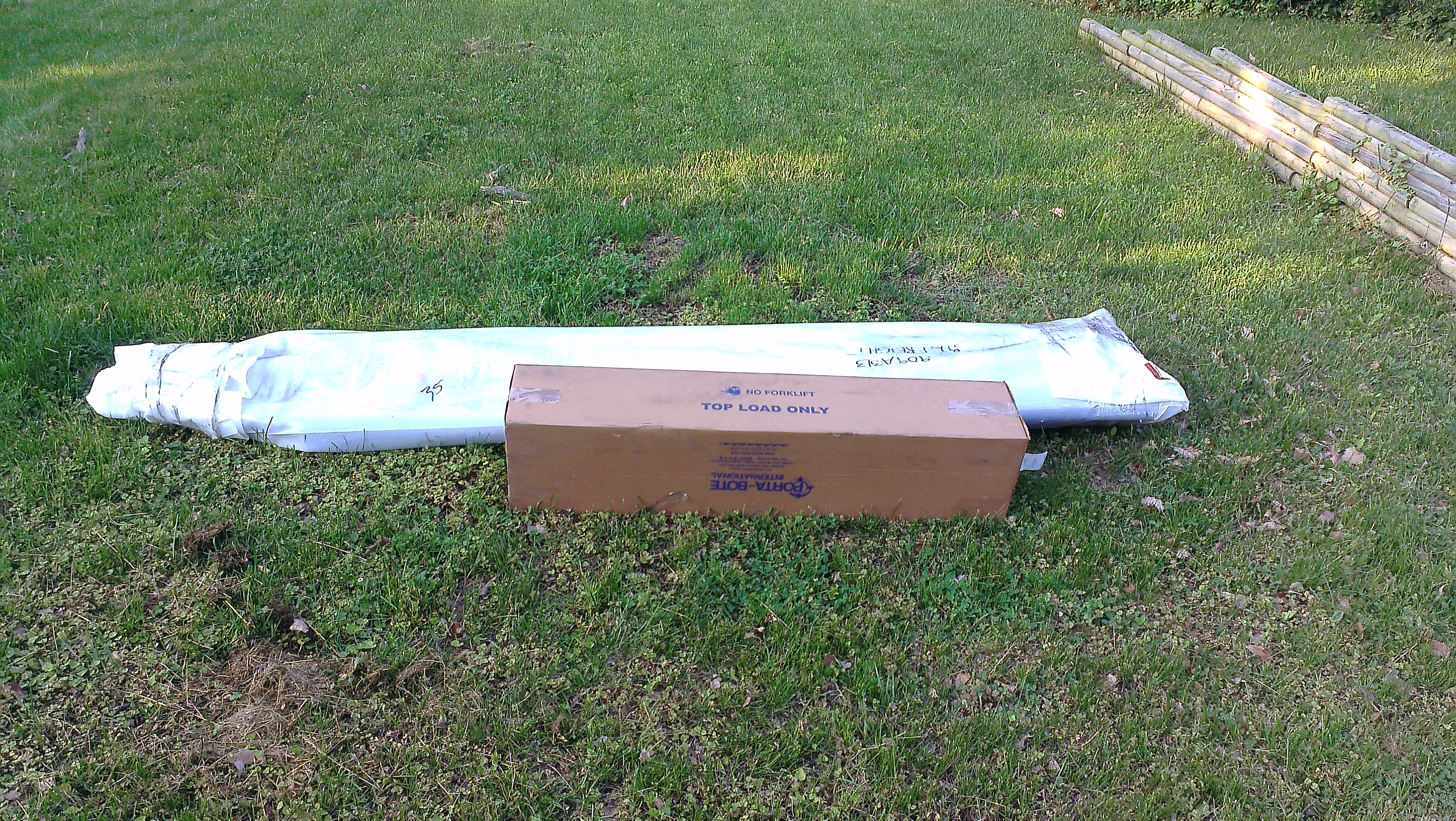
The package, as it arrived. The hull itself is wrapped in a heavy plastic. The seats, oars, and miscellaneous arrived in a big box. The photo loses the sense of scale.
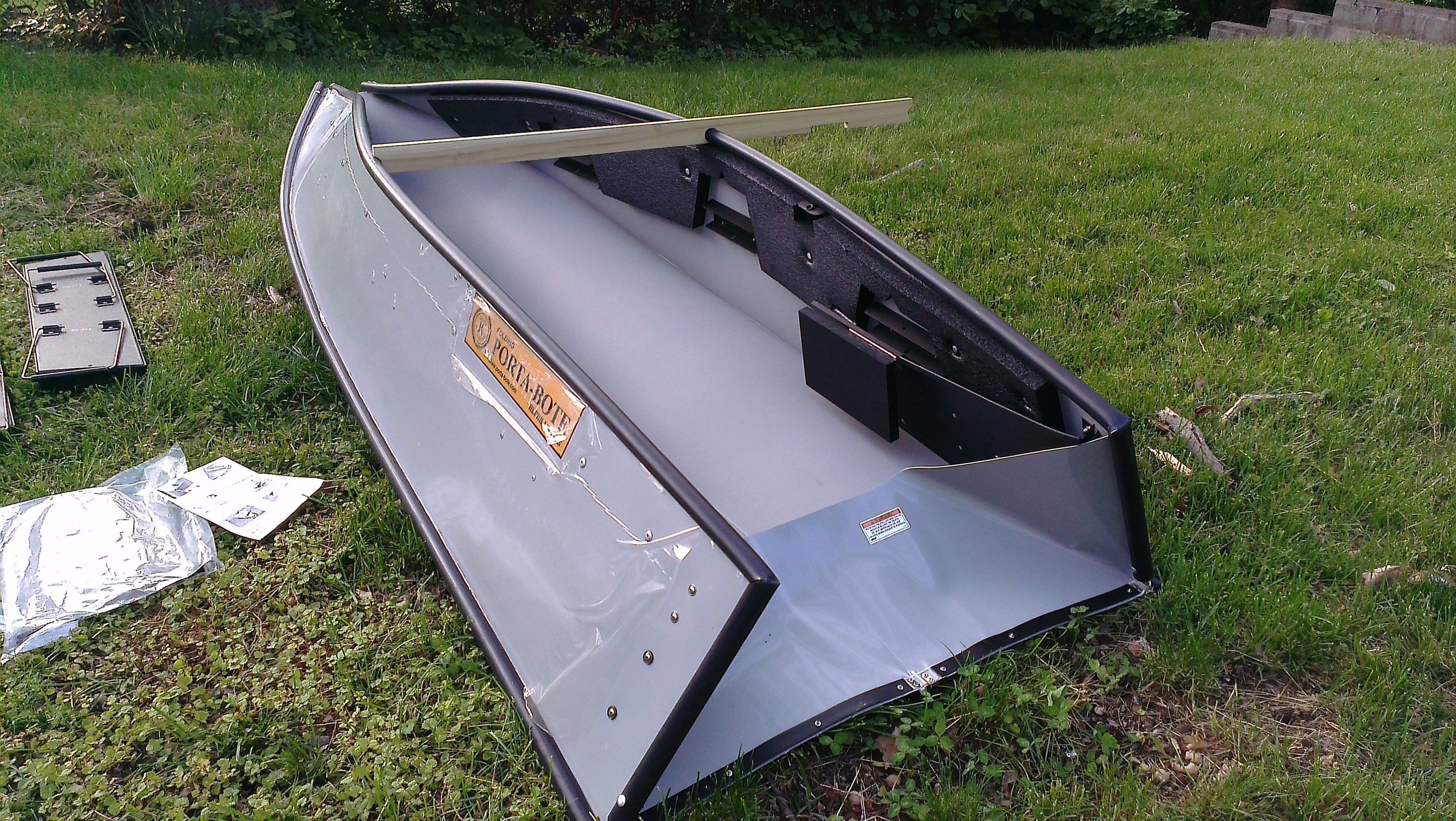
The first unfolding required more effort than I expected. They do include a notched board which helps to force the boat open.
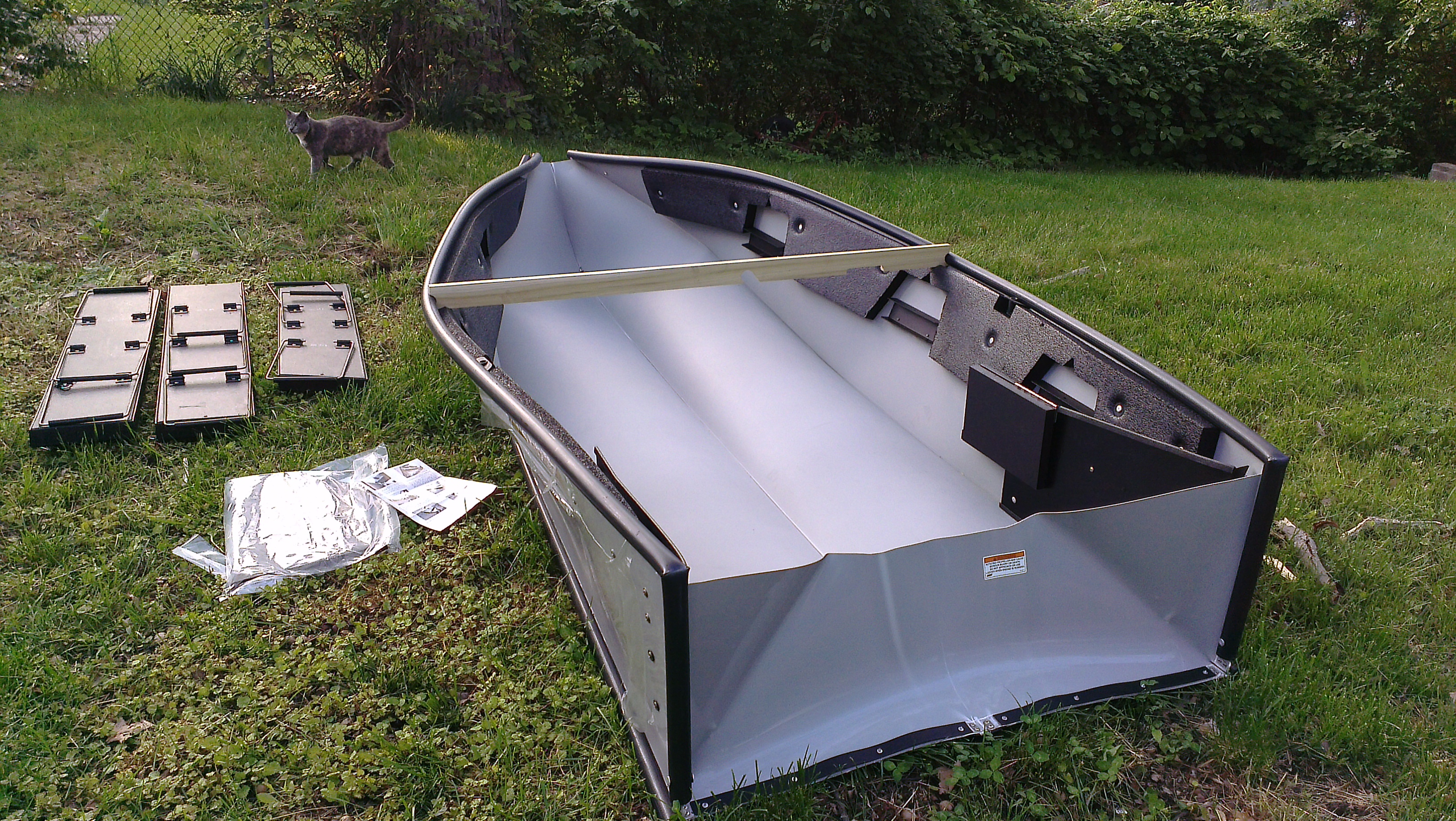
After it is opened up a little, I was able to climb inside and force it all the way open. The included “tool” helps keep it spread.
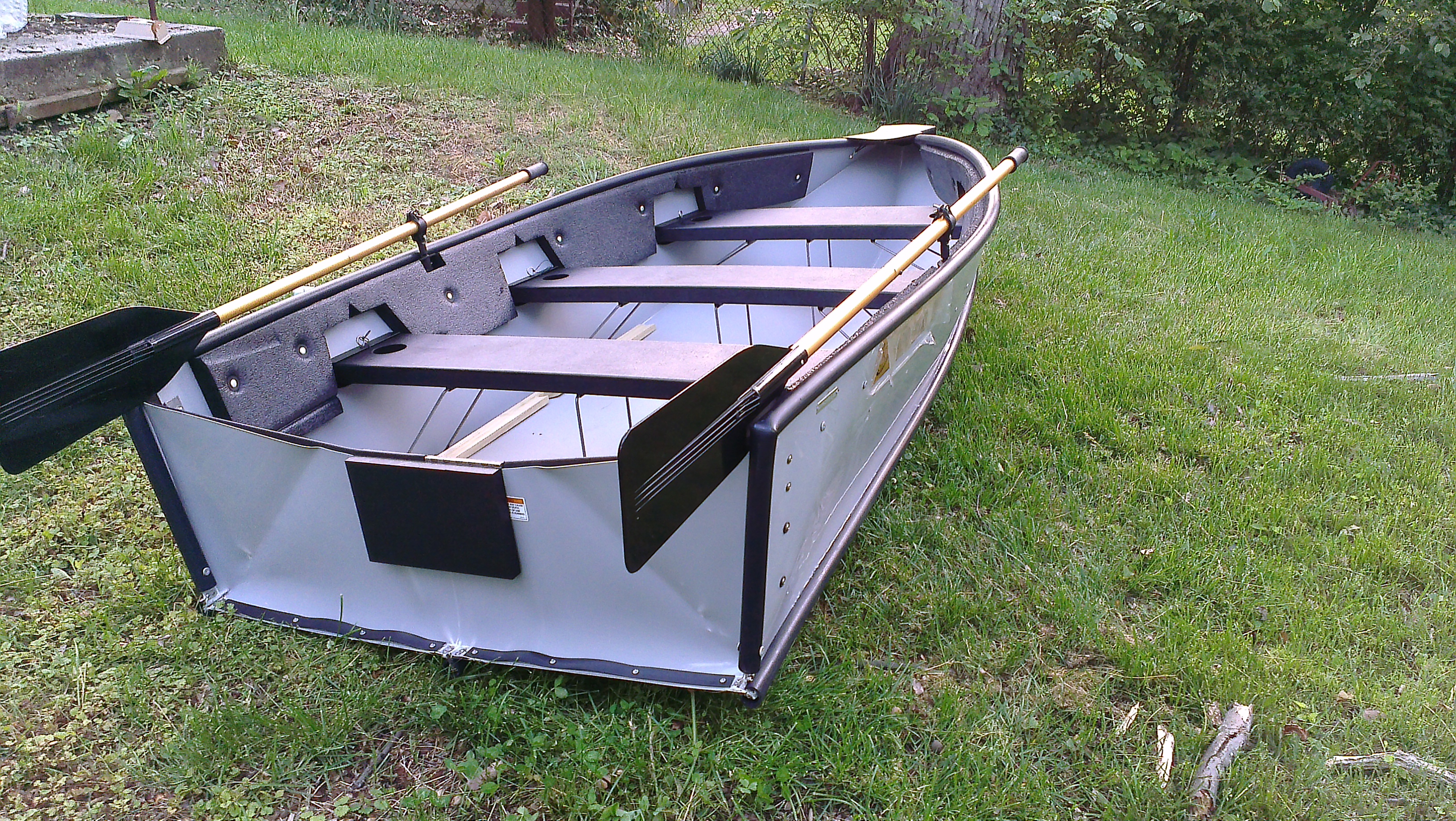
Then it’s just a matter of locking the transom in place (the new version…I understand this is a recent upgrade) and installing all the seats. There is definitely a front and back to each of the seats. They aren’t marked so it is necessary to pay attention to their shape.
The oars look OK. I’m not a fan of the oar locks, though, and may change them out.
Item 1: My new Bayfield has a propane cooking system. It used to have a propane water heater, too; but I didn’t find it worth the trouble and removed it (eBay, soon). Propane works, it is convenient, it is already installed, it is staying (for anyone thinking about talking me into kerosene or alcohol). The tank lives outboard on the stern pulpit.
Item 2: I’ve been so frustrated with a phantom drain of amps in the boat, I decided to redo the entire electrical system. It is now much improved (and almost done). I’ve used modern, properly sized boat wire everyplace. I’ve broken circuits out into a couple different panels. I have a battery monitor. I’m happy. Or at least I was…
The problem: I finally got around to hooking up the xintrex S-2 (preëxisting) propane sniffer/solenoid control to house power this past weekend. As expected, the solenoid burns about one amp, which is totally acceptable. What is less acceptable is the propane sniffers (one in the bilge, one in the cabinet directly under the stove) burn around .5 or .6 amps. Now, given that you’d think that the sniffers should be turned on whenever the boat is occupied (and maybe always, depending on your philosophy), I find that the 12 amp-hrs or more a day, just for monitoring, to be an overly serious drain on my limited battery (and charging) capacity. THIS is clearly a big contributor to my phantom battery drain.
The solution: As far as I know, sniffers are not required equipment. However, they do seem rather prudent. I’m thinking of wiring the Xintrex control/sniffer system up to a spare switch on the circuit breaker panel. I figure a decent compromise might be to throw the switch whenever the valve on the tank is on. When I’m well done with whatever cooking I’m doing, I could close the manual valve, and kill the Xintrex at the panel. This has the advantage of saving some electrons and giving me a third place to kill the propane if necessary (at the xintrex control panel, at the tank, and now at the electrical panel). It has the disadvantage of losing full-time monitoring.
I think with the tank at the rail, the solenoid at the tank, and the new propane line entering the hull through a vapor tight-fitting, that I’m covering the important safety bases. Am I missing something?
I can be the worst sort of blogger: a blogger who doesn’t blog. Dammit! Time got away from me. Again.
In any case, things have been happening over the winter, although far slower than I would like. In an effort to write something, anything, here is a quick somewhat long-winded run down of this winter’s boat refit projects:
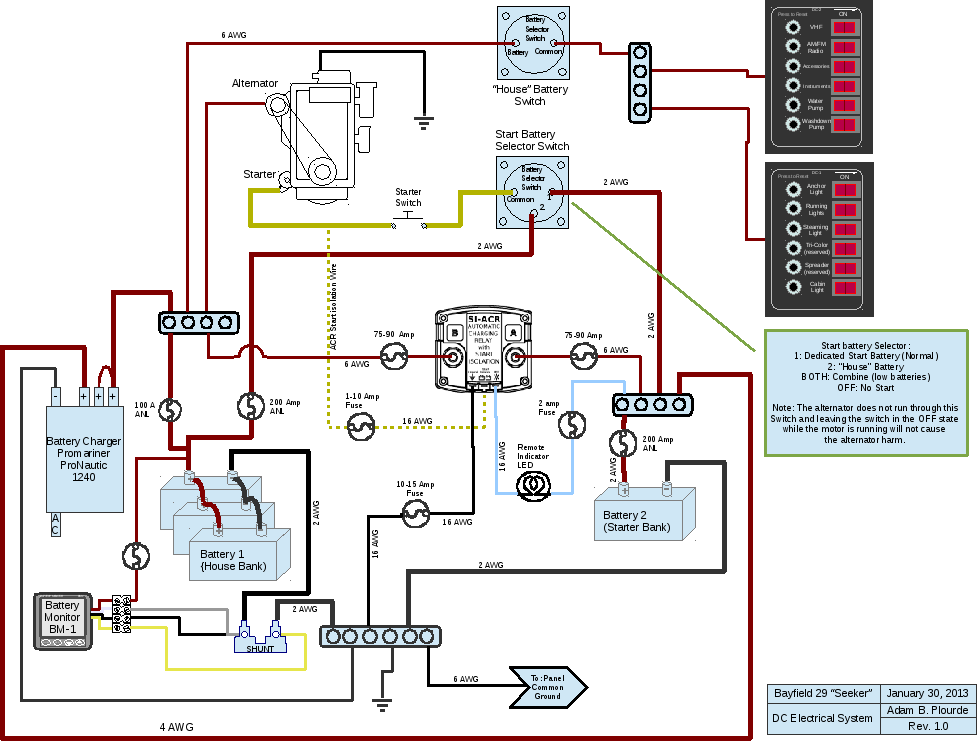
I am in the process of redoing the entire electrical system. Entirely. AC and DC. Everything is coming out and being replaced. I am unhappy with the existing DC system, especially with a mystery current draw when everything is supposed to be powered off, so this seems like a good time to take care of the system. The small panel next to the galley is being replaced with a larger panel next to the nav station (where it really belongs). Wire is being properly sized (the wash down pump, all the way in the bow, was wired with 16 AWG, as was the pressure water system…now, with 12 AWG wire, the lights don’t dim), as are all the breakers. I’m trying very hard to do everything according to modern standards. I installed a battery monitor which is really cool. I’m installing lots of twelve volt outlets (I hate not having a convenient outlet when I need it). A new stereo and a new VHF with built-in AIS reception is also going into the panel. A CO detector is now installed. A bilge water alarm is being installed (insurance company insists) as is a second electric bilge pump in the little sump area behind the engine if I can find a way to shoehorn it in. New batteries will be going in, wired together with an Automatic Charge Relay so I don’t have to worry about juggling the battery on/off/both switch during charging. In fact, I am installing one new switch for house power and one for engine. I purchased four 20 watt solar panels that will be mounted on the dodger. A couple new LED dome lights have been installed. Incandescent interior bulbs have been replaced with LED and I hope to do the same with my NAV lights. There is a lot more, I’m sure. It’s coming along, slowly. Here is a general (although far from comprehensive and not quite up to date) diagram for how things are wired up…I think this will work pretty well.
I did pull out the not-really-functioning air-conditioner and was going to install a brand new one; but I decided to order a new dinghy (porta-bote) instead as my old home-built dinghy went with my Seafarer (sadly wrecked by the new owner ) when I sold her. I may regret that should I move aboard this summer. If so, I am keeping the thru-hulls in place, and I have strung new 120v AC wiring so that I can install a new unit reasonably painlessly without having to haul the boat. In theory anyhow.
The old holding tank is out-a-there, as is the old Grocco toilet and nearly all the associated plumbing. I am just about ready to install the Nature’s Head Dry Composting Toilet. Unfortunately, the extra height of the new toilet is interfering with the doors of the cabinet behind it. More work <sigh>.
Mom came down for a few days a couple of weeks ago to help me with the hull prep. Lots of sanding and scraping but it is more or less ready for new bottom paint. The previous owners raised the waterline over the bootstripe. I guess I’ll leave it that way for this year. We’ll see how she sits. Mom also helped with the teak which is great, although there is an awful lot left to do. The old name is gone and the boat is ready to receive her new identity. I can’t wait as I was never really happy with the old name.
The new anchor system will hopefully be installed in the next week or two. A Rocna 10 (22 pounds), with 90 feet of ¼” high tensile chain and ½” 8-plait line on a big roller. I bought a second, matching, roller that should be here in a couple of days that will allow me to keep two anchors on the bow, although I haven’t decided on the second set yet.
There is a lot more to do (always); but hopefully I’ll be able to launch by the end of May. I had intended on trying to sail to Martha’s Vineyard for the Father’s Day party that many of my friends have there that weekend; but that no longer looks realistic as I will be lucky to get Seeker launched at that point, and I am not anxious to try everything out the first time on a big (relatively speaking…it’s not exactly crossing the Atlantic; but it would be my biggest passage as skipper) trip. Instead I think I may try for the Newport Folk Festival at the end of July. That plan would allow Lauren to accompany me as I attempt to get her to fall in love with the whole idea of travel by sea. Unfortunately, work may mess up my plans.
Yes, the traditional “Hello World!” first post.
At the moment this may be all that is here. But soon, I hope, I will include photos and stories of the updates, upgrades, modifications, maintenance, and sailing of adventures of me and my lovely little Bayfield 29 Cutter “Seeker.” I’m a bit more than a one trick pony, though, so don’t be surprised if you find some other content here regarding other adventures I hope to have.
What you will probably not find here is a lot of noise regarding politics or religion unless it is directly related to boating or cruising. Firearms aboard while cruising? Valid topic. Anchoring rights? Valid topic. Right to carry (firearms) legislation? Probably not a valid topic. Abortion? Definitely not a valid topic. You get the idea…
Edit: I have ported over a bunch of related posts from my Blogger page. Just kind of filling in some of the blanks…